
Five ways parents can support their child’s learning through the Easter break
As the Easter holiday break draws closer, students will be looking forward to a well-deserved, long two week break from school. However, as a parent, I also understand that this can be a time where you start to wonder how you can support your child’s learning outside of the classroom. Below are my top five tips to nurturing your child’s learning over the Easter holiday break.
Help your child develop a growth mindset
Growth mindset is a self-belief that one can improve their abilities through persistence and practice in any area, academically, socially, and emotionally. Neuroscientists have discovered so much more about the brain in recent years and the most compelling finding is that our brains are much more capable of learning throughout our lives when we have a growth mindset.
The first step to facilitating a growth mindset is to foster a life-long love for learning. This means understanding that learning is not restricted to the classroom. Learning can happen anywhere; and now that the days are longer, warmer and brighter, there is no better time than to take learning outside to create a more fun, engaging and child-led approach to learning.

The ingredients needed are curiosity, a desire to discover, and embracing making mistakes as a part of learning. One way to help facilitate a growth mindset is with language. You can model saying, “I can’t do this yet” and “I’m still learning how to do this” instead of “I can’t do this”. Help your child change their narrative, too. Model and encourage persistence and perseverance. Engage in puzzles, building, and creative tasks with children to give them time to practice these skills.
Develop positive habits and routines at home
Instilling positive habits and routines will benefit all aspects of your child’s life. One simple, easy habit to cultivate at home is reading. Reading does not need to be restricted to bedtime, and it doesn’t need to be seen as a form of homework that is done with absolute focus in silence. Instead, it can easily be done in a mix of environments. It can be reading road signs around your community, reading as a family instead of watching TV, or even during a family picnic or a trip to the beach. Reading is the perfect activity to weave into family time, and it will help your child to relax and enjoy their time away, all while continuing to learn.
Other examples include establishing and maintaining morning and evening routines, daily chores around the house, and playtime both independently and together.
Nature is a classroom
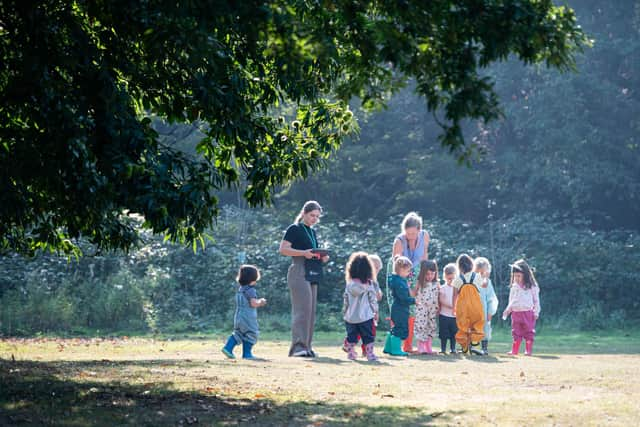
Nature is a vital space for learning, and gives your child the chance to explore, make decisions, solve problems and follow their curiosities. With warmer weather on the way, Easter is the perfect time to encourage your child to observe the great outdoors and ask questions. Nature is more vibrant and interesting in the warmer months as more animals and insects roam free, so facilitating that experience for your child can be an inspiring moment in their journey as a learner.
Spending time in nature creates authentic learning experiences, and helps them to feel more connected to themselves, their family and the world around them.
Help your children learn about themselves
The Easter break gives your child the chance to take a breath, reflect, and learn about themselves as individuals. Talk with your child and guide them through the process of reflecting on their strengths, the challenges they face and what strategies they can use to improve. By implementing this now over a couple of weeks, your child can practice for the longer breaks, such as summer and Christmas holidays, and can continue to evaluate what works for them.
As parents, it is no secret that we are busy and it can be tempting to fill every spare moment of holiday time with activities and trips. Yet, it is important to allow for downtime. In fact, a crucial part of guiding children through the process of self-understanding is to allow them to be bored and navigate it to enhance their self-awareness and find inspiration. It can be frustrating when your child says, “I’m bored!” but it’s important to not give in to curing that boredom with an iPad or a movie, and instead encourage them to overcome their boredom and follow their curiosities. At this time of year, fun can be found in activities outside just as much as inside.
Set short-term targets
Create goals together for your week or even for each day. Consider short term, achievable goals that will set your children up for success. Ask your child what they want to work on doing better over the holiday. This might be keeping their bedroom tidy or having more patience with a sibling or reading every day. Tell your child what you notice as well and what you would like them to work on. For example, for a child who rarely eats much of their dinner, setting a target to eat their whole meal every night for a week is daunting and unlikely to be successful. The first target might be to eat three bites of every item on their plate (or one bite depending on the child). Once this is achieved, this can be celebrated and then set the next target. Praise your child with specifics. Instead of just “well done!” try, “you ate more of your dinner tonight! That will help you grow stronger” or “you ate more of your dinner tonight. Now you will have more energy”. Praise what they did well and why it is so great. This is one step toward building intrinsic motivation for continued growth.
Let them work things out
The path to independence is full of twists and turns and an abundance of problem solving opportunities. Throw caution to the wind and give your child space and time to ponder and try out possible solutions. The possibilities are endless and range widely from sorting out disputes with a sibling, cleaning up after themselves, figuring out what to do when too much toothpaste comes out of the tube, or how to entertain themselves, such as riding their bikes, going for a walk or playing sports outside.
We are not here to give our children all of the answers to all of their problems, rather, we are here to give them the tools to problem-solve and gain independence. When we allow children the time, space, and tools to find solutions, we support their internal process for problem solving and communication, which are vital skills to becoming independent, life-long learners both in and out of the classroom.
By Lyn Fiez-Vandal, Lower School Assistant Principal at ACS International School Cobham