
Surrey woman diagnosed with AVM after suffering what she thought were ‘work stress’ headaches
Alicja Faryniarz was taken to hospital after suffering a stroke during a tennis match and was diagnosed with AVM.
A Surrey woman was left paralysed after headaches she thought were 'work stress' turned out to be signs of a brain disease.
Alicja Faryniarz, 44, said she knew something 'wasn't right' but her symptoms were constantly dismissed by doctors as migraines or sinus problems.
The accountant began suffering from severe headaches during her 20s which led to fainting episodes and extreme fatigue.
However each time she went to her GP, she says they "brushed it aside" and prescribed her with painkillers despite her suffering "intense pain".
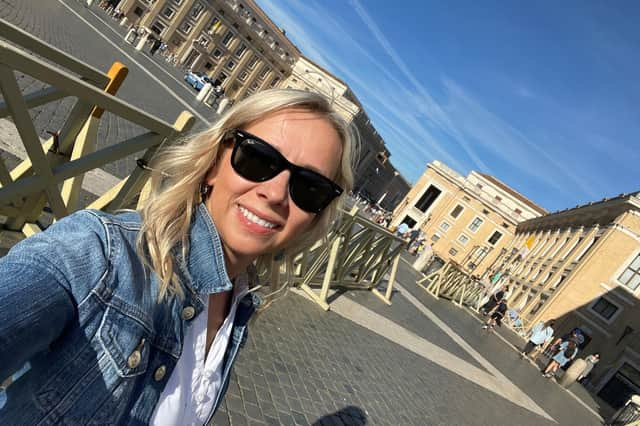

It wasn't until September last year that her brain disease was picked up when she suffered a stroke while playing a tennis match.
Brain Arteriovenous Malformation (AVM)
Alicja collapsed on the court and was taken to hospital where she was diagnosed with brain arteriovenous malformation (AVM).
AVM affects less than 1 per cent of Brits and is caused by tangled blood vessels that create irregular connections between arteries and veins in the brain.
They are usually congenital, but they can form later in life, and people with the disease rarely show symptoms, according to the NHS.
Alicja had a three inch AVM which ruptured and paralysed the right side of her body and also left her in a coma for three days.
She is now warning of the "hidden" dangers of the rare condition which she had no idea she was born with.
Alicja, from Cobham, Surrey, said: "My life ended on the day I had the stroke and I'm still trying to get it back.
"I've had to give up my life as I can no longer enjoy the things I loved like cycling, running, dancing, walking my dog, the list goes on.
"If I was given a CT scan instead of doctors brushing it aside, I believe they would have found it and none of this would have happened. I'm no longer the same person."
Alicja believes her AVM rupture was triggered by stress at work which weakened her blood vessels.
She also believes a blood donation she made the week before could have made her blood thicker and the exercise then extra put stress on her veins.
She said: "I had a lot of plates spinning and life was very overwhelming at times.
"I would have these severe headaches where I would have to pause work and lie down for a moment and take some time until it passed."
Alicja first noticed symptoms in her early 20s after suffering with severe headaches and fainting episodes.
She said doctors gave her painkillers to deal with the "horrific pain" and she continued with her daily life, still exercising regularly and going to work.
But following her move to the UK from Poland in 2004 her symptoms got worse as she began suffering with more frequent headaches and extreme fatigue.
It wasn't until 2021 during the COVID pandemic when she had her first extreme fainting episode after she collapsed in her bathroom and suffered a black eye and concussion.
Alicja said: "I had collapsed and hit my head on the bathroom tiles.
"An ambulance was called but they only arrived the next day and as I had COVID at the time they wouldn't take me to the hospital."
Alicja believes that if she was taken to the hospital and had a brain scan performed, they would have found the AVM.
She went on to suffer three more fainting episodes until her stroke on September 3 last year.
Recalling the day, she said: "I had worked from home and had travelled to Esher Tennis Club for an end of summer competition.
"The past weekend I had been on a 115km bike ride and went on a walk with friends and to be honest I wasn't feeling to well but I had gotten used to it.
"I played the first game fine, but then during the second match I hadn't played for very long when my vision went blurry and I had a really intense headache.
"I remember collapsing to the floor not being able to move or speak and being in agony - I was terrified and thought I was dying."
Alicja said an ambulance didn't arrive for two hours before she was transported to St Peter's Hospital in Chertsey where she was put into an induced coma.
She was then transported to London's St George's Hospital and placed on the ICU unit until she awoke three days later on September 6.
Alicja said: "When I woke up I was unable to move the right side of my body and I couldn't speak.
"It took me two weeks just to be able to move my middle finger a little."
Alicja stayed at St George's hospital until September 22 when she was moved to Woking Community Hospital for just over a month.
Now a year on. Alicja can talk, move her right arm, but she can no longer walk without the aid of a walking stick or a wheelchair.
She said: "If you know or think something is wrong make sure you get it checked out.
"I'm sharing my story as I want to spread awareness that it could happen to anybody."