
New amber warning issued amid risk of thunderstorms in Sussex and Surrey; 'significant' flooding is possible

A new amber weather warning has been issued, amid the risk of thunderstorms in Sussex and Surrey.
The Met Office has now announced three warnings, which affect the South East of the country.
The first yellow alert – which runs from 9pm until 11.59pm on Friday (July 18) – warns: “Scattered showers and a few thunderstorms may cause some impacts later on Friday evening.”
A separate yellow warning is in place from midnight until 9pm on Saturday (July 18).
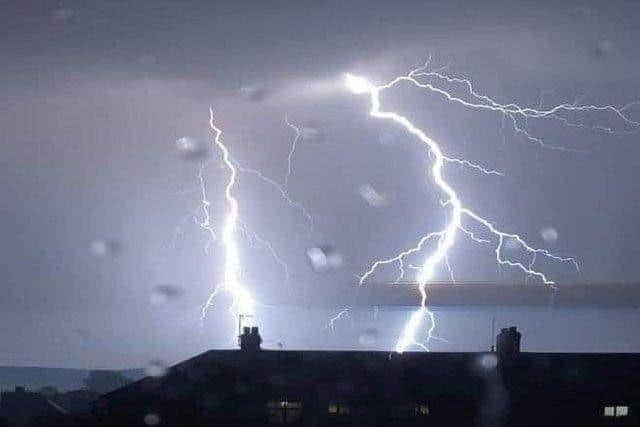

This warns that heavy rain, with some thunderstorms, ‘may lead to disruption in places’ on Friday night and ‘through much of Saturday’.
At 4am, an amber warning comes into force until 11am.
This reads: “Torrential rain, with thunderstorms in places, could lead to some significant surface water flooding during Saturday morning.”
What does an amber warning mean – and what should people expect?
The Met Office warned that some communities are ‘likely to become cut off if roads flood’.
This warning only impacts London & South East England and the East of England.
The weather experts added: “Where flooding or lightning strikes occur, delays and some cancellations to train and bus services are likely.
"Spray and sudden flooding probably leading to difficult driving conditions and some road closures.
"Power cuts likely to occur and other services to some homes and businesses could be lost.
"Flooding of homes and businesses is likely and could happen quickly, with damage to some buildings from floodwater, lightning strikes, hail or strong winds.
"Fast flowing or deep floodwater is likely, causing danger to life.”
Areas of heavy rain, ‘with embedded thunderstorms’, will move northwards during the early hours of Saturday, with ‘torrential downpours in places’.
The forecast reads: “Accumulations of 20-40 mm are possible in one hour, and where heavy downpours persist then as much as 70-100 mm could accumulate in just a few hours.
"Significant impacts are possible if this occurs over more urban areas.
"The more widespread heavy rain should clear to the north during Saturday morning, but additional scattered heavy showers and a few thunderstorms could develop during Saturday afternoon and early evening, this risk covered by the much larger yellow thunderstorm warning."
The government agency provided some advice about what people should do in the event of an amber warning:
– “Keep yourself and others safe; prepare to avoid travelling by road during potentially dangerous road conditions. If you must travel, ensure you watch for possible danger and drive cautiously;
– “It is not safe to drive, walk or swim through floodwater, avoid it where possible and if you are affected by fast flowing or deep-water call 999, and wait for help;
– “Preparing a flood kit could save you from loss or damage due to flooding to your home or business. Include: insurance and any other important documents; a torch & spare batteries; first aid kit, prescription medicines and supplies for looking after your family members or pets such as warm, waterproof clothes, blankets, food, and water;
– “Being outside in high winds and/or lightning makes you more vulnerable to injury. Stay indoors as much as possible. If outside, try not to walk, or shelter, close to buildings or trees, or other structures which could be struck by lightning. If you hear thunder, and are unable to get to a safe enclosed shelter (such as a car), crouch down in a ball-like position with your head tucked in and hands over your ears making minimal contact with the ground, away from objects that conduct electricity;
– “Before gusty winds arrive, check to ensure moveable objects or temporary structures are well secured. Items include; bins, garden furniture, trampolines, tents, gazebos, sheds, and fences;
– “Consider checking on vulnerable people that you know including older people, those with underlying conditions and those who live alone; they may need support with food and medical supplies;
– “If you are worried about your health or that of somebody you know, ring NHS 111;
– “Stay up to date with the weather forecast for your area and follow advice from emergency services and local authorities.”
What about a yellow warning?
This means that spray and sudden flooding ‘could lead to difficult driving conditions’ and ‘some road closures’, the Met Office said.
The government agency added: “Where flooding or lightning strikes occur, there is a chance of delays and some cancellations to train and bus services.
"Power cuts might occur and other services to some homes and businesses could be lost.
"Flooding of homes and businesses could happen quickly, with damage to some buildings from floodwater, lightning strikes, hail or strong winds.
"Fast flowing or deep floodwater is possible, causing a danger to life.
"Some communities might become cut off if roads flood.”
Areas of heavy rain, ‘with embedded thunderstorms’, will move north-westwards across a large swathe of central and eastern England through Friday night into Saturday.
The Met Office added: “Rain will likely be torrential in places, bringing 20-30 mm in less than an hour, with 60-90 mm in two to three hours possible in a few places.
"Whilst more widespread heavy rain will gradually clear north-westwards during Saturday, additional scattered heavy showers and thunderstorms may develop in its wake during Saturday afternoon and early evening, before eventually decaying later.”
As well as heavy rain, impacts from ‘frequent lightning, gusty winds and large hail’ are ‘also likely’.
Here is some advice, from the Met Office, about what people should do in the event of a yellow warning:
– “Consider if your location is at risk of flash flooding. If so, consider preparing a flood plan and an emergency flood kit;
– “Prepare to protect your property and people from injury. Before gusty winds arrive, check to ensure moveable objects or temporary structures are well secured. Items include; bins, garden furniture, trampolines, tents, gazebos, sheds, and fences;
– “Give yourself the best chance of avoiding delays by checking road conditions if driving, or bus and train timetables, amending your travel plans if necessary;
– “People cope better with power cuts when they have prepared for them in advance. It’s easy to do; consider gathering torches and batteries, a mobile phone power pack and other essential items.
– “If you find yourself outside and hear thunder, protect yourself by finding a safe enclosed shelter (such as a car). Do not shelter under or near trees, or other structures which may be struck by lightning. If you are on an elevated area move to lower ground;
– “Be prepared for weather warnings to change quickly: when a weather warning is issued, the Met Office recommends staying up to date with the weather forecast in your area.”
Find out more at https://weather.metoffice.gov.uk/warnings-and-advice/uk-warnings#